
A Village Hall Concert, Two Cameras Down: Notes from Live Coverage
6 min read
Daniel recounts a community concert streamed to relatives abroad, and how the multi-camera plan changed when the hall's layout and the evening's running order shifted.
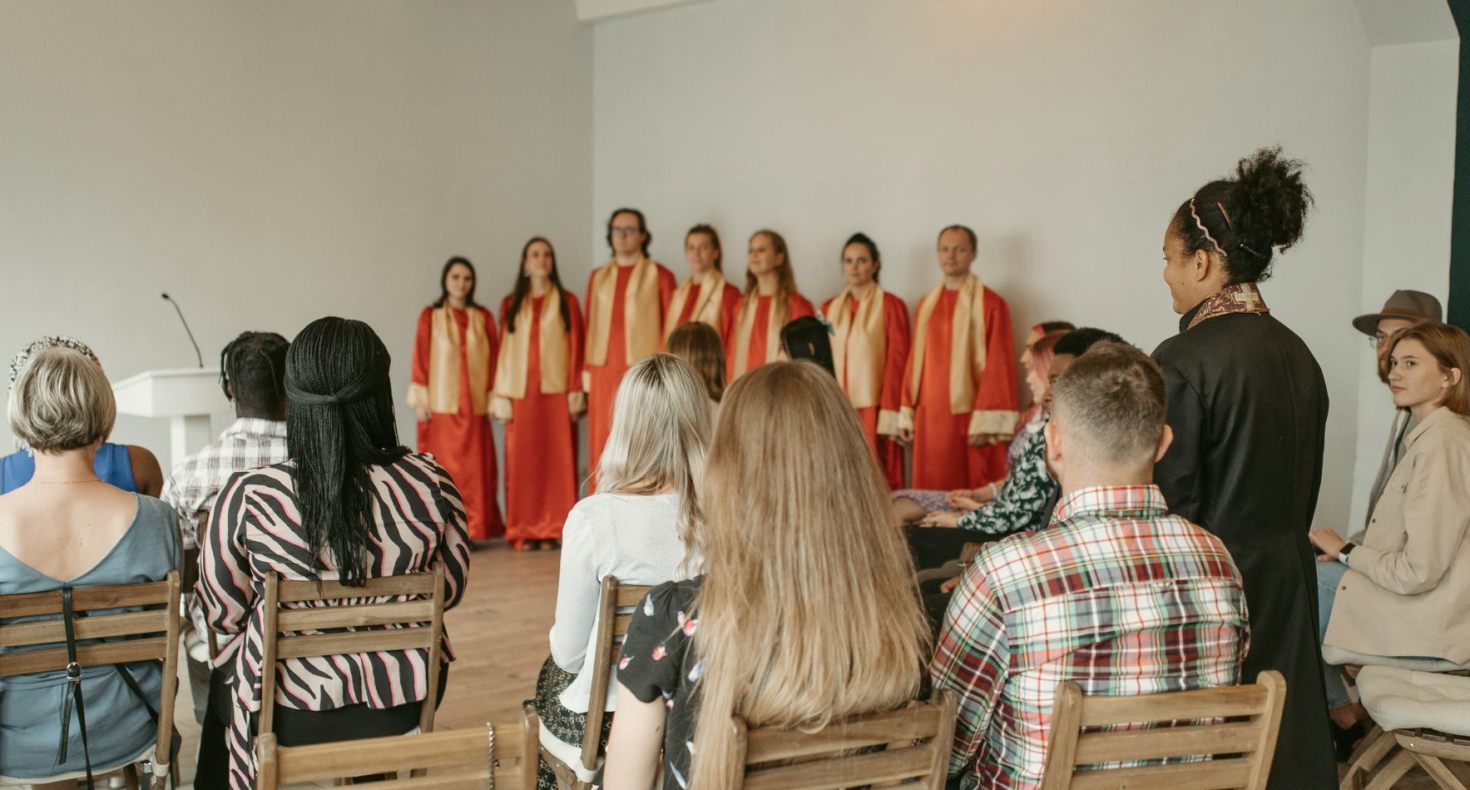
The call from Marguerite
Marguerite rang us in early autumn on behalf of a village hall committee outside Chester. They were holding their annual choir concert and wanted relatives in other countries to watch it live. She had no broadcast background and said so plainly, which made the first conversation easier. She knew the hall, she knew the running order, and she knew roughly how many people would turn up. What she did not know was how many cameras it takes to make a concert watchable on a laptop screen. I asked her for three things: a plan of the hall, the list of performers, and the names of any speakers. We agreed a site visit before anything was written down.
Her brief was simple and honest. Family members were scattered across several time zones, and some were elderly and unfamiliar with streaming. She wanted a picture they could follow without fuss, and sound that carried the singing rather than the shuffle of chairs. She also wanted the audience in the room to forget we were there. That last request shaped most of our decisions, from where the operators stood to how we routed cable along the walls rather than across the floor.
Walking the hall before agreeing a plan
The visit took an hour on a grey weekday afternoon. The hall had a raised stage at one end, a low ceiling with fluorescent tubes, and a side door that opened straight onto the car park. We measured sight lines from the back wall and from both aisles, and I noted where daylight would fall during the early part of the evening. A site visit tells you things a floor plan cannot. The stage was shallower than the drawing suggested, so a camera placed where Marguerite expected it would have shown the choir in a flat row with no depth.
We talked through power as well. The hall had a limited number of sockets, and the kitchen shared a circuit with the stage lighting. That mattered because a kettle going on mid-interval could have tripped the supply. Priya, who plans our schedules and signal paths, drew up a cable route and a power list that same evening, and we sent both to the committee so the caretaker knew what to expect on the day.
Choosing positions for the cameras
We settled on three positions. A wide camera sat at the back of the hall on a fixed tripod, giving a steady view of the whole stage. A second camera stood in the left aisle at a slight angle, picking up faces and the conductor. A third, handheld by an operator who stayed low, covered close shots and the audience reactions that families love to see. Three is not a magic number. It was what the room could carry without anyone in the audience losing their view or tripping over a lead.
Each camera had a clear job, which made switching straightforward. The wide shot was the safe fallback, the angled shot carried most of the performance, and the handheld camera was used sparingly for moments of warmth. We briefed the operators with a shot list built from the running order, so they knew which soloist stood where and when the speeches began. Marguerite read the list too and corrected two names, which saved us an awkward caption later.
Sound that carries a choir
Owen took charge of audio. A choir in a modest hall is trickier than it looks, because the room adds its own echo and the singers are spread across the width of the stage. He placed two condenser microphones above the front row, angled to catch the whole group evenly, and added a separate microphone for the speakers and the piano. He monitored on headphones throughout, listening for the moment when applause crept into the mix too loudly or a page turn became audible.
The aim was a balance that sounded natural to someone watching on a tablet in another country. Too much room sound made the singing distant, too little made it sterile. Owen settled on a blend and rode the levels gently as the programme moved from quiet hymns to livelier numbers. We ran a rehearsal with the choir during their warm-up, which let us check the stream on a separate laptop in the car park. Marguerite listened there with a cup of tea and asked only for the piano to be a touch louder.
When the running order changed
On the evening, the programme shifted. A soloist who had been placed in the second half arrived early and the committee decided to bring her forward, with a short speech from the chair following her. This is the sort of change that ruins a plan built too rigidly. Because our switching followed the shot list loosely rather than a script, the vision mixer simply moved to the angled camera and the operators adjusted. Priya relayed the new order over the talkback to every position within a minute, and nobody on the stream saw a flicker of confusion.
The stream itself ran cleanly. We had set a modest bitrate suited to the hall's connection, and a backup route in case the primary line dropped. It did not need the backup, but the committee felt reassured knowing it was there. About forty relatives watched live, according to the figures Marguerite later passed on, and a handful sent messages to be read out at the interval. That small exchange between a hall in Cheshire and living rooms elsewhere was the real point of the evening.
What the evening taught us
Small events deserve the same care as large ones, just scaled to the room. The visit, the cable plan and the briefing took more effort than the transmission itself, and they are the reason it felt effortless.
We also learned to ask early about anything that could change on the night, because running orders are rarely as fixed as they look on paper. Marguerite said afterwards that the thing she noticed most was how little she noticed us. For a live event, that is about the best thing a client can say.
Live coverage of a community event comes down to preparation that the audience never sees: a visit to the room, a sensible number of cameras, clean sound and a crew that can adapt when the evening changes. Marguerite's concert was modest in scale and generous in feeling, and it reminded us why we plan the dull parts carefully. If you are organising something similar, tell us about the venue and the programme, and we will talk it through with you.